Sachi
The Earthquake BirdSachi is Teiji’s former lover, but the novel gives her no direct account of their relationship and little independent presence outside Teiji’s photographs and Lucy’s interpretations. First encountered as a scowling woman in an image, she becomes a shadowy predecessor whose apparent decline and disappearance unsettle Lucy. Sachi matters not only as part of Teiji’s past: the place she occupies in his photograph boxes gives physical form to Lucy’s fear that intimacy can be archived, displaced, and lost.
Identity and Introduction
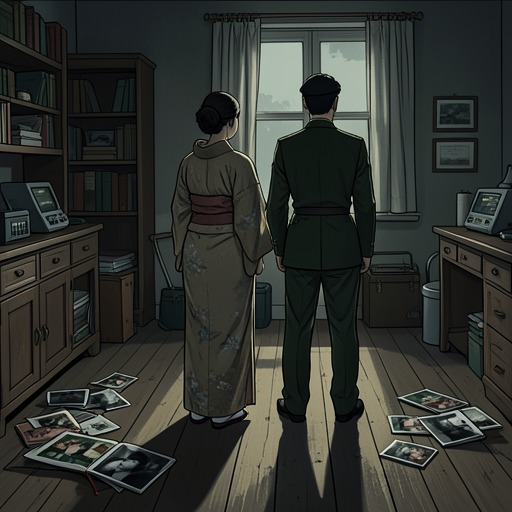
Lucy first sees Sachi among the pictures she has no permission to examine. After Teiji leaves his apartment, Lucy lets herself in with a spare key hidden beside the door and searches a box chronicling his years in Tokyo. She passes over his childhood photographs and skips the earliest period of his life in the city, looking instead for the years before he met her. Among familiar images of water, pavement, stations, and tunnels, she finds a photograph of a young woman looking out through a bus window. The woman has a rounded face, deeply set eyes, and a chin-length bob; her tired, angry expression seems to Lucy a scowl.
At first Lucy can only wonder whether this woman was Teiji’s lover before her. When she asks, Teiji identifies her as Sachi. He says that their relationship ended, that Sachi left, and that he has not tried to find her. He also tells Lucy that he has found her and no longer thinks about Sachi. His account establishes the basic outline of their former relationship while leaving its duration, circumstances, and ending unexplained. Sachi’s departure is presented as a fact; what it meant to her, and where she went, remain unknown.
The Story in Teiji’s Photographs
Lucy follows Sachi backward through the photographs to what appears to be the earliest image of her: a distant view of a small theater stage. Sachi is the only actor, dressed in a soldier’s uniform with a gun over her shoulder, her mouth open in a silent shout. Lucy cannot tell whether Teiji attended because he already knew Sachi or discovered her at the play. There is no earlier photograph of Sachi to settle the question. Before the theater image, the box contains a few pictures of a man in the noodle shop, smiling stiffly at the camera with damp, reddened eyes.
The later photographs suggest a change in the life Teiji recorded. Sachi appears in other theatrical settings and in different costumes, though her face is often difficult to make out. In subsequent pictures she is at coffee shops, parks, beside a river, and at parties. Gradually, there are fewer images of her as an actress and more of her seated at gatherings on worn tatami or on a bed. Lucy reads a visible deterioration in the sequence: Sachi’s face looks fuller and paler, her expression increasingly sad, and her fitted clothes become crumpled and stained. The last photograph Lucy sees shows her lying face down on pavement, her head turned aside and the corners of her mouth raised in an expression Lucy cannot distinguish as a grimace or a smile. Lucy guesses that Sachi may have been drunk, but the image does not establish what happened to her.
The photographs provide a chronology without an explanation. Their ordering lets Lucy watch Sachi move from the stage into increasingly private and unhappy-looking scenes, but it does not disclose the causes of that change or prove what her life was like beyond the camera’s view. Sachi is therefore both a person represented in the images and an absence produced by them: the pictures preserve moments while withholding the context that would make her story certain.
Lucy’s Identification with Sachi
Teiji’s reassurance does not make the photographs easier for Lucy to forget. She insists to herself that she is not jealous in the sense of believing Teiji still loves Sachi, yet cannot stop thinking about her. The arrangement of the box becomes an intimate ranking: Sachi lies in the middle, Lucy’s own pictures are at the top, and Lucy believes her position is better than Sachi’s. What frightens her is the possibility that her photographs will eventually be covered by a new layer, leaving her to disappear into the same figurative darkness she imagines for Sachi.
Because Lucy has so little reliable information, she invents stories about the woman. She wonders about the bleak parties in the photographs and why Sachi seems to become unhappier and sicker. In time, Lucy begins to feel that Sachi is someone she has always known, even imagining her as a sister. This imagined kinship is not evidence of a relationship between the two women; it is Lucy’s response to a stranger whose place in Teiji’s past resembles the vulnerable place she fears occupying herself.
Sachi also becomes a point of comparison when Lucy recalls that she slept with Brian Church. Lucy speculates that Teiji might have thought of Brian as belonging to the past, much as Sachi did, and that bringing him back into the present could not be undone. The association shows how Lucy understands old attachments: an ended relationship may be declared finished, but its return in memory can still alter the present. Her conjecture does not reveal Teiji’s thoughts; it records Lucy’s uncertainty about how he receives her history.
Recurrence and Unresolved Significance
After her friendship with Lily and her relationship with Teiji have broken down, Lucy walks through the night along the Yamanote Line, following the tracks from station to station. In Shinjuku, near the place where she first encountered Teiji, she thinks again of Sachi and of the small theater where Teiji may have found her. Lucy had imagined Sachi as buried in a remote past, but the city’s linked stations prompt a different possibility: that Teiji moved from Sachi to Lucy and then from Lucy to Lily with little distance between them. The sequence is Lucy’s speculation, not a confirmed account of Teiji’s relationships. Its force comes from the way a physical route makes her imagine intimacy as a series of stops on a track.
Sachi returns at the novel’s end as part of Lucy’s suspicion that Teiji may have killed Lily. Lucy wonders whether a meeting between Teiji and Lily, and the possibility that Teiji might lose both women, could have given him a reason to kill. She asks whether murder might be connected to his habit of taking photographs and keeping images, then immediately qualifies the thought: the evidence is circumstantial, and she of all people should not judge too quickly. Nothing in Sachi’s photographs or Teiji’s brief explanation establishes that he harmed her. Instead, Sachi’s unresolved fate intensifies Lucy’s questions about what Teiji preserves, what he leaves behind, and whether an image can disclose violence without proving it. Her story remains deliberately incomplete: the photographs show a woman’s changing appearance, Teiji confirms that she left, and Lucy is left to confront how much of the rest she has supplied herself.